
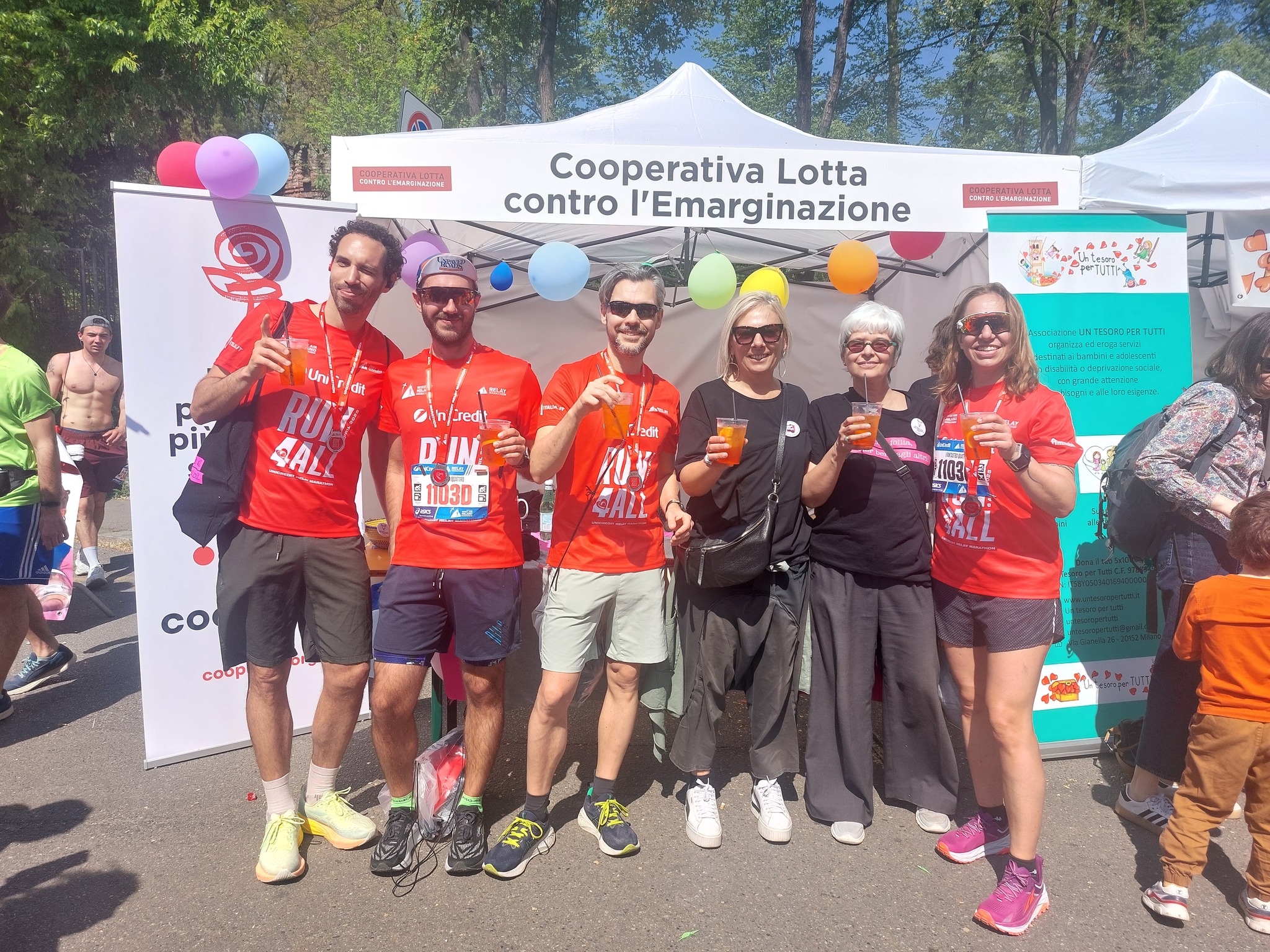

Cooperativa Lotta contro l’Emarginazione
In 2025, Cooperativa Lotta contro l’Emarginazione celebrated its 45th anniversary!
Founded with a focus on mental health, over the years it has faced challenges and innovations of social change and both regional and national welfare systems, evolving into a multifaceted organization.
Today, it operates in the fields of addiction and youth substance use, mental health, disability, youth empowerment, social vulnerability, abuse, childhood, immigration and human trafficking, education, HIV, juvenile justice, internal and external penal execution.
It is active in the areas of Milan, Monza and Brianza, Varese, Sondrio, Como, Brescia, and Piacenza.
Key words: prevention and culture!
It is now well established that gender-based violence is rooted, above all, in a cultural context shaped by ingrained stereotypes and longstanding habits.
Before becoming a concrete act of violence—whether physical, psychological, or economic—perpetrated by a man against a woman, it is a cultural issue.
In order to truly change course and reduce (or even eliminate) this violence, in addition to supporting women victims of abuse, we must also work on prevention.
With the fundraising we will carry out through the Milano City Marathon, we want to bring to the northern area of Milan a prevention project that we have developed and tested in the Varese area over the past two years.
We will work with children and youth aged 3 to 18.
We will work with classes from preschool through high school: the more funds we raise, the more classes we will be able to reach with our project!
The project we aim to support involves two years of work with each class group:
- First year: we address themes related to gender roles and stereotypes, helping students to recognize the cultural elements that harbor dynamics of inequality and domination in relationships.
- Second year: we focus on change: we encourage the development of attitudes and behaviors free from violence and domination, promoting equal relationships that respect individual consent.
Why at school?
The school environment represents a cross-section of everyday normalcy that few other places offer: a mix of social backgrounds and cultural origins allows us to reach a broad segment of the population without filtering by social category.
The younger the target group, the less entrenched gender stereotypes are, and the greater the willingness to engage imagination, creativity, and spontaneity. Reaching children and youth early in their critical thinking development has a positive impact on their perceptions and behavior.
The transition between the last year of primary school and the beginning of lower secondary school is a key moment: boys and girls are especially influenced by “patriarchal” culture and tend to conform to stereotyped behavior codes to gain easier social recognition.
Introducing opportunities for critical reflection at this stage helps them distance themselves from the collective imaginary that pushes them toward standardized and stereotyped gender roles.
Adolescence is a phase in which peer pressure and influence are at their peak: during this time, the opinions of peers are the most significant in shaping behavior. The ability of peers to share their experiences and skills within the classroom strengthens the prevention message and encourages activation among their own peer groups.
Adults and Community
Adults in the school environment are often only partially aware of how much they are influenced by a culture steeped in stereotypes and violence in relationships. When properly engaged, they try to adopt alternative strategies in their interactions with children and youth.
Teachers and parents also need to be guided through a process of awareness that allows them to concretely envision practices that promote gender equality and prevent gender-based domination—of which they may sometimes be unconscious carriers.